 | ||
| ||
 | ||
|
| ||
|
Tuesday, December 25, 2012


Monday, August 6, 2012
Buddhist Studies with E-books
The Followings are the Information on Buddhist Studies
If you are interested, please feel free to visit:
Monday, July 23, 2012
Resources for the Study of Cambodia
American Embassy, Phnom Penh, Cambodia: http://usembassy.state.gov/cambodia/
ASSOCIATION FRANCAISE POUR LA RECHERCHE SUR L'ASIE DU SUD-EST http://www.afrase.org/
Ask Asia: http://www.askasia.org
Association française de solidarité: http://www.afs-cambodge.com/
Australia Aid for Center for Khmer Studies http://khmerstudies.org/
Friends of Khmer Culture http://www.khmerculture.net/
Heritage Watch http://www.heritagewatchinternational.org/
KhmeRennaisance (in Khmer) http://www.khmerenaissance.info/
National Archives of Cambodia http://www.nac.gov.kh/english/index.php
National Library of Cambodia http://carnetsdasie-pp.com/index.php
National Museum of Cambodia http://www.cambodiamuseum.info/index.html
Cambodia Fund: http://www.aacf.ws/
Bibliotheque Langues Orientales: http://www.univ-paris3.fr/bibliotheque/rattachees/langueorientale/index.... Cambodge Soir: http://cambodianews.free.fr/cambodge_soir.htm
Cambodia Daily: http://www.cambodiadaily.com/
Cambodia, East & Southeast Asia: An Annotated Directory of Internet Sources: http://newton.uor.edu/Departments&Programs/AsianStudiesDept/cambodia.html
Cambodia Genocide Database: http://www.yale.edu/cgp/databases.html
Cambodia Genocide Program, Yale Univeristy: http://www.yale.edu/cgp
Cambodia Hotels Net: http://www.cambodia-hotels.net/
Cambodian Information Center: http://www.cambodia.org/news/
Cambodia Portal.com: http://cambodiaportal.com
Cambodia Post: http://www.cambodiapost.com/
Cambodia News: http://groups.yahoo.com/group/CambodiaNews/messages
Cambodia News Net: www.thecambodianews.net
Cambodian Auto-Genocide Page: http://www.cybercambodia.com/dachs/
Cambodian Genocide Program, Maps of Cambodia, Yale University: http://www.yale.edu/cgp/maps.html Cambodian Genocide Program, Photographic Database (CTS), Yale University: http://www.yale.edu/cgp/img.html Cambodian Institute for Cooperation and Peace: http://www.cicp.org.kh
Cambodian Virtual Library: http://web.archive.org/web/20040213121640/www.iias.nl/wwwvl/southeas/cam...
Centre Culturel et Social Khmère de la Suisse: http://www.khmer.ch
Centre for Khmer Studies/Centre des Etudes khmères: http://www.khmerstudies.org Communications Cambodge: http://www.cambodge.com/
Council of Ministers: http://www.camnet.com.kh/ocm/
Dith Pran Holocaust Awareness Project: http://www.dithpran.org/
Documentation Center of Cambodia: http://www.dccam.org/
Enfants du Mékong: http://www.enfantsdumekong.com/
Forum.Org.Khmer: http://www.forum.org.kh/
Indochina Center: http://www.OCF.Berkeley.EDU/~sdenney/ Institut national de la santé publique/
National Institute of Public Health: http://www.camnet.com.kh/nphri
Japanese International Cooperation Agency: http://www.jica.go.jp/cambodia/english/
Khemara House http://www.cambodia.org/clubs/khemara/
Khmer Krom Network: http://www.khmerkrom.net/
Khmer Unity Party: http://kup.free.fr/
Khmers Kampuchea-Krom Federation: http://www.khmerkrom.org/
Kingdom of Cambodia: http://cambodianews.free.fr/
Les Jeunes Khmers de France: http://www.lesjeuneskhmers.com
Ministry of Eductation, Youth & Sport: http://www.moeys.gov.kh/
Ministry of Posts & Telecommunications: http://www.mptc.gov.kh/
National Assembly of the Kingdom of Cambodia: http://www.cambodian-parliament.org/
National Library of Cambodia: http://www.nla.gov.au/lap/libs/cambodia.html
National Institute of Stastics: http://www.nis.gov.kh/
Norodom Sihanouk, King of Cambodia, Films: http://www.norodomsihanouk.org Onlinenewspapers.com: http://www.onlinenewspapers.com/cambodia.htm
Phnom Penh Daily: http://www.phnompenhdaily.com/
Phnom Penh Post: http://www.PhnomPenhPost.com/
Permanent Mission of the Kingdom of Cambodia in the United Nations: http://www.un.int/cambodia/
Recherches-Enseignement-Annonces: http://groups.yahoo.com/group/VietnamLaosCambodge/
Royal Government of Cambodia: http://www.cambodia.gov.kh/
Sculpture of Angkor and Ancient Cambodia, National Gallery of Art, USA: http://www.nga.gov/exhibitions/camwel.htm
Senate of the Kingdom of Cambodia: http://www.khmersenate.org/
South and Southeast Asian Association for the Study of Culture and Religion www.sseasr.org
Radio Free Asia: http://www.rfa.org/khmer/
Sam Rainsy Party: http://www.samrainsyparty.org/
United Nations in Cambodia: http://www.un.org.kh/
Vietnam Archive: http://www.lib.ttu.edu/vietnam/Holdings/holdings.htm
Vietnam-Laos-Cambodge http://www.cseas.kyoto-u.ac.jp/seas/seas_pdf_en.htm
Buddhist Studies Web resources: http://www.ciolek.com/WWWVLPages/BuddhPages/MetaResources.html
ASSOCIATION FRANCAISE POUR LA RECHERCHE SUR L'ASIE DU SUD-EST http://www.afrase.org/
Ask Asia: http://www.askasia.org
Association française de solidarité: http://www.afs-cambodge.com/
Australia Aid for Center for Khmer Studies http://khmerstudies.org/
Friends of Khmer Culture http://www.khmerculture.net/
Heritage Watch http://www.heritagewatchinternational.org/
KhmeRennaisance (in Khmer) http://www.khmerenaissance.info/
National Archives of Cambodia http://www.nac.gov.kh/english/index.php
National Library of Cambodia http://carnetsdasie-pp.com/index.php
National Museum of Cambodia http://www.cambodiamuseum.info/index.html
Cambodia Fund: http://www.aacf.ws/
Bibliotheque Langues Orientales: http://www.univ-paris3.fr/bibliotheque/rattachees/langueorientale/index.... Cambodge Soir: http://cambodianews.free.fr/cambodge_soir.htm
Cambodia Daily: http://www.cambodiadaily.com/
Cambodia, East & Southeast Asia: An Annotated Directory of Internet Sources: http://newton.uor.edu/Departments&Programs/AsianStudiesDept/cambodia.html
Cambodia Genocide Database: http://www.yale.edu/cgp/databases.html
Cambodia Genocide Program, Yale Univeristy: http://www.yale.edu/cgp
Cambodia Hotels Net: http://www.cambodia-hotels.net/
Cambodian Information Center: http://www.cambodia.org/news/
Cambodia Portal.com: http://cambodiaportal.com
Cambodia Post: http://www.cambodiapost.com/
Cambodia News: http://groups.yahoo.com/group/CambodiaNews/messages
Cambodia News Net: www.thecambodianews.net
Cambodian Auto-Genocide Page: http://www.cybercambodia.com/dachs/
Cambodian Genocide Program, Maps of Cambodia, Yale University: http://www.yale.edu/cgp/maps.html Cambodian Genocide Program, Photographic Database (CTS), Yale University: http://www.yale.edu/cgp/img.html Cambodian Institute for Cooperation and Peace: http://www.cicp.org.kh
Cambodian Virtual Library: http://web.archive.org/web/20040213121640/www.iias.nl/wwwvl/southeas/cam...
Centre Culturel et Social Khmère de la Suisse: http://www.khmer.ch
Centre for Khmer Studies/Centre des Etudes khmères: http://www.khmerstudies.org Communications Cambodge: http://www.cambodge.com/
Council of Ministers: http://www.camnet.com.kh/ocm/
Dith Pran Holocaust Awareness Project: http://www.dithpran.org/
Documentation Center of Cambodia: http://www.dccam.org/
Enfants du Mékong: http://www.enfantsdumekong.com/
Forum.Org.Khmer: http://www.forum.org.kh/
Indochina Center: http://www.OCF.Berkeley.EDU/~sdenney/ Institut national de la santé publique/
National Institute of Public Health: http://www.camnet.com.kh/nphri
Japanese International Cooperation Agency: http://www.jica.go.jp/cambodia/english/
Khemara House http://www.cambodia.org/clubs/khemara/
Khmer Krom Network: http://www.khmerkrom.net/
Khmer Unity Party: http://kup.free.fr/
Khmers Kampuchea-Krom Federation: http://www.khmerkrom.org/
Kingdom of Cambodia: http://cambodianews.free.fr/
Les Jeunes Khmers de France: http://www.lesjeuneskhmers.com
Ministry of Eductation, Youth & Sport: http://www.moeys.gov.kh/
Ministry of Posts & Telecommunications: http://www.mptc.gov.kh/
National Assembly of the Kingdom of Cambodia: http://www.cambodian-parliament.org/
National Library of Cambodia: http://www.nla.gov.au/lap/libs/cambodia.html
National Institute of Stastics: http://www.nis.gov.kh/
Norodom Sihanouk, King of Cambodia, Films: http://www.norodomsihanouk.org Onlinenewspapers.com: http://www.onlinenewspapers.com/cambodia.htm
Phnom Penh Daily: http://www.phnompenhdaily.com/
Phnom Penh Post: http://www.PhnomPenhPost.com/
Permanent Mission of the Kingdom of Cambodia in the United Nations: http://www.un.int/cambodia/
Recherches-Enseignement-Annonces: http://groups.yahoo.com/group/VietnamLaosCambodge/
Royal Government of Cambodia: http://www.cambodia.gov.kh/
Sculpture of Angkor and Ancient Cambodia, National Gallery of Art, USA: http://www.nga.gov/exhibitions/camwel.htm
Senate of the Kingdom of Cambodia: http://www.khmersenate.org/
South and Southeast Asian Association for the Study of Culture and Religion www.sseasr.org
Radio Free Asia: http://www.rfa.org/khmer/
Sam Rainsy Party: http://www.samrainsyparty.org/
United Nations in Cambodia: http://www.un.org.kh/
Vietnam Archive: http://www.lib.ttu.edu/vietnam/Holdings/holdings.htm
Vietnam-Laos-Cambodge http://www.cseas.kyoto-u.ac.jp/seas/seas_pdf_en.htm
Buddhist Studies Web resources: http://www.ciolek.com/WWWVLPages/BuddhPages/MetaResources.html
Monday, July 9, 2012
CHANBOKEO
Useful website for Cambodia Studies produced by Chanbokeo
This website you will find many information such as Culture, history, literature, painting, drawing and many more.. please read more
This website you will find many information such as Culture, history, literature, painting, drawing and many more.. please read more
Thursday, June 7, 2012
Spirits of the Forest: Cambodia’s Kuy People Practice Spirit-based Conservation
May 14, 2012
Author:
Neal Keating
CSQ Issue:
36-2 (Summer 2012) 40 years of Advocacy
The Kuy believe that Ah’ret (sprits) live in the trees. Making offerings in places where they dwell is required to maintain positive
relations.
© Neal Keating
It was late in the Cambodian afternoon
as my Kuy colleagues, Mr. Pak and Mr. Vansakd, and I followed Mr. Phon
(a Kuy community leader and elder) down the narrow dirt road leading out of the Kuy village of Svay Damnak to go into the forest. Svay Damnak is located in southern
Preah Vihear, on the outskirts of the Boeng Per Wildlife Reserve, a
forested area that is part of the greater Prey Lang forest area. Along
the way, Mr. Phon pointed out to us the ancient mango tree that symbolizes the ancient founding of the village in the days before Angkor Wat. At the foot of the tree we saw a small open hut that provided a shrine for one of the local Ah’ret (spirits). Nearby were srai fields where people were working to prepare the ground for transplanting the young rice shoots
they had grown.
As we stepped into the forest we felt instant relief from the hot sun. The large and diverse forest cover provided a lush umbrella under which the fragrant air of the many different plants around us circulated freely. As we proceeded deeper into the forest we eventually came to a cemetery (phno kmaucht), where the grave mounds of the dead were interspersed in the small distances between the trees. Mr. Phon explained that it was important to keep the dead far away from the village, and that they were happier to be in the forest. The forest also provides people with numerous medicine roots, bark, and other materials for living. We continued our walk from the forest through interspersed fields of mixed cultivation (voh srei dad dal), that included many tall dipterocarp trees from which people obtain useful resins (ut charl dtut). We visited the overgrown site of a looted Chenla temple, and crossed the old raised road that runs in a straight line from Svay Damnak west to the old city of Angkor Wat, once the largest urban center in the world.
We finally came to rest under a large dipterocarp tree growing on top of a small hill made out of tons of iron slag left behind by ancient Kuy shamans (chây) who long ago danced the solid ore into molten liquid for blacksmiths (val dtat) to render into tools for use and trade with the elites of Angkor Wat. As we walked back to the village through the forests and fields, Mr. Phon explained that all of this would be gone soon. Why? The government had just remapped most of their territory as an economic land concession, and leased it to a transnational corporation that aims to convert it into an industrial plantation of rubber, cashew and acacia trees. Most of the Boeng Per Reserve has recently met the same outcome: it is gone.
Mr. Phon told us he recently had an opportunity to speak directly to the director of the company that plans to develop the new plantation on Kuy territory. He told us that he said “no” to the director, and that the Kuy people did not consent to this concession. The director’s reply was that the land currently being farmed by community members would not be taken, but that the rest would. The “rest” includes the large areas of diverse forests we had walked through. To help me understand this, Mr. Phon drew a picture for me. First, he drew a large rectangle and said, “This is our land.”
Then he drew a very small circle in the middle of the rectangle and said, “This is what the company said we will be able to keep, to farm.” When I asked how one would get to the farming area, Mr. Phon explained the company’s plan by drawing a line from the edge of the rectangle to the circle and explained that the company proposed to provide a small road to the remaining farmland, but that he and the other Kuy people would have to pay an access toll. When the company director explained this to Mr. Phon, Mr. Phon again disagreed, and that is where the “consultation” ended.
Such encounters, devoid of anything resembling free, prior and informed consent, are commonplace throughout Cambodia. They are not just cultural norms; they are enabled by a political climate of force that generates transnational wealth.
In talking with Mr. Ra, a young Kuy farmer, he clearly explained how this works. He said a company came and took his land, and he cannot complain about it because he fears he will get punished by the police or soldiers. In talking about this fear with Mr. Sochea, the leader of an important Indigenous organization, he said that yes, there is a general fear in the country that if you publicly complain about one thing (like having your land taken away), you risk causing even bigger problems for yourself (like getting arrested or worse).
Indigenous Peoples in Cambodia Today
There are more than 20 different ethnic groups in Cambodia who self-identify not as Khmer, but as distinct Indigenous Peoples of the uplands and mountains, with different cultures, languages and histories than those of the lowland Khmer peoples. Historically, these peoples have been referred to by Khmers and others (e.g., French colonials, Chinese traders, etc.) as ethnic minorities, hill tribes, Khmer Loue, and more dehumanizing terms associated with wildness, primitivity, savagery, and so forth. Most of their traditional territories are today reconstituted as the provinces of Mondulkiri, Rattanakiri, Kratie, Steung Treng, Kampong Thom, and Preah Vihear. Because these people chose to live different lifestyles, they have been targets of discrimination through centuries of multiple colonialisms. But in 2012, the problems facing Indigenous Peoples in Cambodia are shared with millions of poor rural and urban Khmer people throughout the country, lowlands and uplands alike. They are basic economic, political and biological problems of survival within an increasingly predatory and menacing state environment that is largely supported by the international system. What is going on now is perhaps the most devastating colonialism of them all: that of the market economy and “development.” In the name of free market development, the Cambodian government is rapidly and increasingly selling off the country’s lands and natural resources to the highest bidder, with little or no benefit to the people who already live there. This is what “land-grabbing” means in Cambodia.
It is not uncommon for Westerners and some Cambodians to describe Cambodia as a place cursed by a recurring fate of human tragedy enabled by a Southeast Asian tradition of patron-client relations based on inequality, and structural proclivities for enacting disproportionate revenge on perceived enemies. While there is certainly truth in these explanations, they overlook the modern role played by the international system in promulgating relations of inequality within Cambodia, a role in dire need of critical self-reflection. Other sorts of relationships have an equally long tradition in the uplands, such as mutual aid and collective autonomy, but these are not favored by the international system.
Kuy Theories of Environment
Although there is variation in Kuy perceptions of their environment, there are some strong recurring patterns of spiritual geography. Primary among these are beliefs in a variety of local spirits that reside in the forests, mountains and near the villages. These spirits have different names, such as Ah’ret, Neak Ta, or Phi. In most of the conversations I had with Kuy people, the most commonly given name was Ah’ret. For most Kuy peoples, the existence of these spirits is fully compatible with the practice of Buddhist or Brahmanic religion. Mrs. Meas, an elder Kuy woman, explained Ah’ret to me as ancestor ghost spirits that will help the people, but they require people to regularly maintain positive communications with them and carry out ceremonies at particular places where they dwell. She said there are four such places at Svay Damnak.
As I learned, the flip-side of this understanding is that if the Ah’ret become angry, they cause illness and death. The Ah’ret are also dangerous; they get upset when people behave badly. Mrs. Meas said that the land-grabbing is angering the Ah’ret. The Ah’ret are key to understanding Kuy culture and the relationships between people and land. Mr. Lot, another Kuy elder, recounted the origin story of Svay Damnak as a royal Cambodian village founded by a king from Bau Khan temple (midway on the road between the village and Angkor Wat), who visited the area and camped under a big mango tree before going to build Angkor Wat. Mr. Lot took us to the same tree that Mr. Phon had shown us, and explained that an Ah’ret lives in that tree; and that the shrine next to the tree houses is the ceremonial stone that is the means by which the people communicate with the Ah’ret. His explanation suggested to me that the shrine is analogous to a cosmic phone booth: when it is time for communication the spirit comes to indwell in the stone as the people draw near the shrine in ceremony, bathe the stone, and offer it tobacco, food, juice, and incense. Traditional musicians may provide music to please the Ah’ret (playng ahrahtnay), using flutes, drums, and other instruments. Mr. Nom, one of the local musicians said that the traditional music can only be played for the Ah’ret and is not meant to be performed otherwise.
Through ceremony, the stone becomes a kind of send-and receive device for messages and expressions between people and Ah’ret. Many women and men in the Kuy villages I visited affirmed the importance of maintaining good relations with the Ah’ret in order to ensure good health and well-being. For example, when illness strikes, Kuy people ask these spirits for their assistance in curing, and go into the forest to procure the necessary materials that are then variously combined to make medicines, that with the help of the Ah’ret remove the malady. The Ah’ret are consulted on many other occasions such as when people prepare fields for planting, need resources from the forest, or want to get married. The need for timber for building houses is particularly sensitive, given that trees are thought to be where Ah’ret normally dwell. Many people told me of the need to carry out ceremonies and appease the Ah’ret before cutting down any trees. Failure to do so can
result in serious illness (banja arall).
Kuy Theories of Development
In many different ways almost all of the Kuy people I spoke with told me that land equals life, and the land includes slowly shifting zones of spirit forests and cultivation fields. If development is change, the change most of the Kuy people I spoke with wanted was to be able to eventually give their children ownership of their lands. An elder and traditional healer, Mr. Ki said that access to traditional lands, territories and resources is important to him because they are for his children’s future living, and that he is unhappy when foreigners come in and take over their lands.
What the Kuy and other Indigenous Peoples would like to change in the present day is the power and impunity of the neoliberal Khmer Riche elites so that they cannot simply sell Kuy lands to a corporation who will then foreclose on traditional Kuy practices of land tenure. This runs almost entirely in opposition to the program of change envisioned by the dominant international model of development to which the Khmer Riche is a party. In effect, Kuy development means stopping this other development. Kuy peoples do not seem interested in developing their economy into something else, but rather stabilizing and ensuring the economy they already have, which follows a complex annual cycle of planting, transplanting, harvesting, and regeneration, and in which local spirits play a critical role. It is not that Kuy people do not want change; they do—they want the political structure to change, so that they have a better chance of surviving, and are able to freely move about their ancestral homeland fields and forests. More than anything else, the Kuy fathers and mothers I spoke to said they wanted to be able to leave their land to their children, to work it much the same way they have. And many of their children expressed assent to the same. The development they seek is that of human dignity.
Kuy theories of environment and development suggest a religiously embedded ecology that has sustained a robust biodiversity and viable habitat over long periods of time. In varying extents, their theories are engaged by other Indigenous Peoples throughout the uplands of Southeast Asia, who have been noted for their state-evasive, anarchic proclivities. It is a human adaptation that has until recently proven to be relatively successful as an alternative response to the multiple lowland state formations that have developed over the last 1,000 years.
There is much the Kuy can teach the rest of the world. Kuy peoples have survived centuries of regional depredations of slave-raids, followed by French colonialism, postcolonial civil war, US carpet-bombing, Khmer Rouge genocide, Vietnamese occupation, and now global neoliberal development. Given their relatively small numbers, they will not survive this latest threat without joining forces with other Indigenous Peoples, alongside and with impoverished Khmer peoples living alongside them in the lowlands and the cities, to generate a peoples’ movement for Springtime
in Cambodia. It remains to see who will join them.
— Neal Keating is Assistant Professor at the Department of Anthropology at College at Brockport, SUNY in New York.
Take Action! You can join the Kuy people and Cultural Survival in our campaign to save the Prey Lang forest. Please see our action alert and more information at www.cs.org/take-action. Write a letter to Cambodia’s prime minister today!
they had grown.
As we stepped into the forest we felt instant relief from the hot sun. The large and diverse forest cover provided a lush umbrella under which the fragrant air of the many different plants around us circulated freely. As we proceeded deeper into the forest we eventually came to a cemetery (phno kmaucht), where the grave mounds of the dead were interspersed in the small distances between the trees. Mr. Phon explained that it was important to keep the dead far away from the village, and that they were happier to be in the forest. The forest also provides people with numerous medicine roots, bark, and other materials for living. We continued our walk from the forest through interspersed fields of mixed cultivation (voh srei dad dal), that included many tall dipterocarp trees from which people obtain useful resins (ut charl dtut). We visited the overgrown site of a looted Chenla temple, and crossed the old raised road that runs in a straight line from Svay Damnak west to the old city of Angkor Wat, once the largest urban center in the world.
We finally came to rest under a large dipterocarp tree growing on top of a small hill made out of tons of iron slag left behind by ancient Kuy shamans (chây) who long ago danced the solid ore into molten liquid for blacksmiths (val dtat) to render into tools for use and trade with the elites of Angkor Wat. As we walked back to the village through the forests and fields, Mr. Phon explained that all of this would be gone soon. Why? The government had just remapped most of their territory as an economic land concession, and leased it to a transnational corporation that aims to convert it into an industrial plantation of rubber, cashew and acacia trees. Most of the Boeng Per Reserve has recently met the same outcome: it is gone.
Mr. Phon told us he recently had an opportunity to speak directly to the director of the company that plans to develop the new plantation on Kuy territory. He told us that he said “no” to the director, and that the Kuy people did not consent to this concession. The director’s reply was that the land currently being farmed by community members would not be taken, but that the rest would. The “rest” includes the large areas of diverse forests we had walked through. To help me understand this, Mr. Phon drew a picture for me. First, he drew a large rectangle and said, “This is our land.”
Then he drew a very small circle in the middle of the rectangle and said, “This is what the company said we will be able to keep, to farm.” When I asked how one would get to the farming area, Mr. Phon explained the company’s plan by drawing a line from the edge of the rectangle to the circle and explained that the company proposed to provide a small road to the remaining farmland, but that he and the other Kuy people would have to pay an access toll. When the company director explained this to Mr. Phon, Mr. Phon again disagreed, and that is where the “consultation” ended.
Such encounters, devoid of anything resembling free, prior and informed consent, are commonplace throughout Cambodia. They are not just cultural norms; they are enabled by a political climate of force that generates transnational wealth.
In talking with Mr. Ra, a young Kuy farmer, he clearly explained how this works. He said a company came and took his land, and he cannot complain about it because he fears he will get punished by the police or soldiers. In talking about this fear with Mr. Sochea, the leader of an important Indigenous organization, he said that yes, there is a general fear in the country that if you publicly complain about one thing (like having your land taken away), you risk causing even bigger problems for yourself (like getting arrested or worse).
Indigenous Peoples in Cambodia Today
There are more than 20 different ethnic groups in Cambodia who self-identify not as Khmer, but as distinct Indigenous Peoples of the uplands and mountains, with different cultures, languages and histories than those of the lowland Khmer peoples. Historically, these peoples have been referred to by Khmers and others (e.g., French colonials, Chinese traders, etc.) as ethnic minorities, hill tribes, Khmer Loue, and more dehumanizing terms associated with wildness, primitivity, savagery, and so forth. Most of their traditional territories are today reconstituted as the provinces of Mondulkiri, Rattanakiri, Kratie, Steung Treng, Kampong Thom, and Preah Vihear. Because these people chose to live different lifestyles, they have been targets of discrimination through centuries of multiple colonialisms. But in 2012, the problems facing Indigenous Peoples in Cambodia are shared with millions of poor rural and urban Khmer people throughout the country, lowlands and uplands alike. They are basic economic, political and biological problems of survival within an increasingly predatory and menacing state environment that is largely supported by the international system. What is going on now is perhaps the most devastating colonialism of them all: that of the market economy and “development.” In the name of free market development, the Cambodian government is rapidly and increasingly selling off the country’s lands and natural resources to the highest bidder, with little or no benefit to the people who already live there. This is what “land-grabbing” means in Cambodia.
It is not uncommon for Westerners and some Cambodians to describe Cambodia as a place cursed by a recurring fate of human tragedy enabled by a Southeast Asian tradition of patron-client relations based on inequality, and structural proclivities for enacting disproportionate revenge on perceived enemies. While there is certainly truth in these explanations, they overlook the modern role played by the international system in promulgating relations of inequality within Cambodia, a role in dire need of critical self-reflection. Other sorts of relationships have an equally long tradition in the uplands, such as mutual aid and collective autonomy, but these are not favored by the international system.
Kuy Theories of Environment
Although there is variation in Kuy perceptions of their environment, there are some strong recurring patterns of spiritual geography. Primary among these are beliefs in a variety of local spirits that reside in the forests, mountains and near the villages. These spirits have different names, such as Ah’ret, Neak Ta, or Phi. In most of the conversations I had with Kuy people, the most commonly given name was Ah’ret. For most Kuy peoples, the existence of these spirits is fully compatible with the practice of Buddhist or Brahmanic religion. Mrs. Meas, an elder Kuy woman, explained Ah’ret to me as ancestor ghost spirits that will help the people, but they require people to regularly maintain positive communications with them and carry out ceremonies at particular places where they dwell. She said there are four such places at Svay Damnak.
As I learned, the flip-side of this understanding is that if the Ah’ret become angry, they cause illness and death. The Ah’ret are also dangerous; they get upset when people behave badly. Mrs. Meas said that the land-grabbing is angering the Ah’ret. The Ah’ret are key to understanding Kuy culture and the relationships between people and land. Mr. Lot, another Kuy elder, recounted the origin story of Svay Damnak as a royal Cambodian village founded by a king from Bau Khan temple (midway on the road between the village and Angkor Wat), who visited the area and camped under a big mango tree before going to build Angkor Wat. Mr. Lot took us to the same tree that Mr. Phon had shown us, and explained that an Ah’ret lives in that tree; and that the shrine next to the tree houses is the ceremonial stone that is the means by which the people communicate with the Ah’ret. His explanation suggested to me that the shrine is analogous to a cosmic phone booth: when it is time for communication the spirit comes to indwell in the stone as the people draw near the shrine in ceremony, bathe the stone, and offer it tobacco, food, juice, and incense. Traditional musicians may provide music to please the Ah’ret (playng ahrahtnay), using flutes, drums, and other instruments. Mr. Nom, one of the local musicians said that the traditional music can only be played for the Ah’ret and is not meant to be performed otherwise.
Through ceremony, the stone becomes a kind of send-and receive device for messages and expressions between people and Ah’ret. Many women and men in the Kuy villages I visited affirmed the importance of maintaining good relations with the Ah’ret in order to ensure good health and well-being. For example, when illness strikes, Kuy people ask these spirits for their assistance in curing, and go into the forest to procure the necessary materials that are then variously combined to make medicines, that with the help of the Ah’ret remove the malady. The Ah’ret are consulted on many other occasions such as when people prepare fields for planting, need resources from the forest, or want to get married. The need for timber for building houses is particularly sensitive, given that trees are thought to be where Ah’ret normally dwell. Many people told me of the need to carry out ceremonies and appease the Ah’ret before cutting down any trees. Failure to do so can
result in serious illness (banja arall).
Kuy Theories of Development
In many different ways almost all of the Kuy people I spoke with told me that land equals life, and the land includes slowly shifting zones of spirit forests and cultivation fields. If development is change, the change most of the Kuy people I spoke with wanted was to be able to eventually give their children ownership of their lands. An elder and traditional healer, Mr. Ki said that access to traditional lands, territories and resources is important to him because they are for his children’s future living, and that he is unhappy when foreigners come in and take over their lands.
What the Kuy and other Indigenous Peoples would like to change in the present day is the power and impunity of the neoliberal Khmer Riche elites so that they cannot simply sell Kuy lands to a corporation who will then foreclose on traditional Kuy practices of land tenure. This runs almost entirely in opposition to the program of change envisioned by the dominant international model of development to which the Khmer Riche is a party. In effect, Kuy development means stopping this other development. Kuy peoples do not seem interested in developing their economy into something else, but rather stabilizing and ensuring the economy they already have, which follows a complex annual cycle of planting, transplanting, harvesting, and regeneration, and in which local spirits play a critical role. It is not that Kuy people do not want change; they do—they want the political structure to change, so that they have a better chance of surviving, and are able to freely move about their ancestral homeland fields and forests. More than anything else, the Kuy fathers and mothers I spoke to said they wanted to be able to leave their land to their children, to work it much the same way they have. And many of their children expressed assent to the same. The development they seek is that of human dignity.
Kuy theories of environment and development suggest a religiously embedded ecology that has sustained a robust biodiversity and viable habitat over long periods of time. In varying extents, their theories are engaged by other Indigenous Peoples throughout the uplands of Southeast Asia, who have been noted for their state-evasive, anarchic proclivities. It is a human adaptation that has until recently proven to be relatively successful as an alternative response to the multiple lowland state formations that have developed over the last 1,000 years.
There is much the Kuy can teach the rest of the world. Kuy peoples have survived centuries of regional depredations of slave-raids, followed by French colonialism, postcolonial civil war, US carpet-bombing, Khmer Rouge genocide, Vietnamese occupation, and now global neoliberal development. Given their relatively small numbers, they will not survive this latest threat without joining forces with other Indigenous Peoples, alongside and with impoverished Khmer peoples living alongside them in the lowlands and the cities, to generate a peoples’ movement for Springtime
in Cambodia. It remains to see who will join them.
— Neal Keating is Assistant Professor at the Department of Anthropology at College at Brockport, SUNY in New York.
Take Action! You can join the Kuy people and Cultural Survival in our campaign to save the Prey Lang forest. Please see our action alert and more information at www.cs.org/take-action. Write a letter to Cambodia’s prime minister today!
Wednesday, June 6, 2012
រដ្ឋាភិបាលខ្មែរកំពុងទាមទារយកវត្ថុបុរាណបដិមាទេវរូបក្នុងសតវត្សរ៍ទី១០មកកម្ពុជាវិញ
From Radio Australia
http://www.radioaustralia.net.au/khmer/radio/onairhighlights/956296http://www.radioaustralia.net.au/khmer/radio/onairhighlights/956296
រដ្ឋាភិបាលខ្មែរកំពុងទាមទារយកវត្ថុបុរាណបដិមាទេវរូបក្នុងសតវត្សរ៍ទី១០មកកម្ពុជាវិញ
ដាក់បញ្ចូលថ្ងៃ 6 June 2012, 17:03 AEST

រូប
ចម្លាក់ថ្មភក់រចនាបទកោះកែរកំពុងតាំងនៅសារមន្ទីរ Metropolitan ។
រូបភាពផ្ដល់ឲ្យដោយលោក ចិន្ដ ច័ន្ទរតនា (Credit: ABC Licensed)
លោកបណ្ឌិត ចិន្ដ ច័ន្ទរតនា
ប្រធានមូលនិធិកេរតំណែលខ្មែរនៅប្រទេសកម្ពុជា
និងជាអ្នកជំនាញខាងបុរាណវិទ្យា
និងប្រវត្ដិសិល្បៈអាស៊ីអាគ្នេយ៍បានមានប្រសាសន៍ប្រាប់វិទ្យុ
អូស្រ្ដាលីឲ្យដឹងអំពីការលួចនៃវត្ថុទាំងនេះយ៉ាងដូច្នេះ។
(សំឡេងលោកបណ្ឌិត ចិន្ដ ច័ន្ទរតនា)
បើ តាមរបាយការណ៍ដែលវិទ្យុអូស្រ្ដាលីទទួលបាន រូបចម្លាក់ទាំងពីរនេះបានត្រូវគេតាំងនៅក្នុងសារមន្ទីរនេះនៅ ឆ្នាំ១៩៩៤។ ដំបូងឡើយតាមរយៈការធ្វើអំណោយព្រះកេសនៃបដិមាទេវរូបទាំងពីរត្រូវ បានគេយកចូលនៅក្នុងឆ្នាំ១៩៨៧ និង១៩៨៩។ បន្ទាប់មកដងខ្លួននៃទេវរូបទាំងពីរ គឺបានទៅដល់សារមន្ទីរនោះនៅឆ្នាំ១៩៩២។ លោកបណ្ឌិត ចិន្ដ ច័ន្ទរតនា ពន្យល់បន្ដអំពីប្រវត្ដិនៃបដិមាទាំងពីរនេះយ៉ាងដូច្នេះ។
(សំឡេងលោកបណ្ឌិត ចិន្ដ ច័ន្ទរតនា)
បច្ចុប្បន្ន នេះរដ្ឋាភិបាលអាម៉េរិកកំពុងតែជួយកម្ពុជាក្នុងការនាំយករូបបដិមា ទេវរូបទាំងពីរអង្គនេះមកប្រទេសកម្ពុជាវិញ។ លោក ផៃ ស៊ីផាន អ្នកនាំពាក្យទីស្ដីការគណៈរដ្ឋមន្រ្ដីនៃប្រទេសកម្ពុជាបានឲ្យដឹង ថា ខាងកម្ពុជាក៏កំពុងតែរៀបចំឯកសារផ្លូវច្បាប់ផងដែរ ដើម្បីទាមទាររករបស់ទាំងនោះមកវិញ។
(សំឡេងលោក ផៃ ស៊ីផាន)
ទាក់ ទងនឹងពេលវេលាថា តើគេត្រូវចំណាយពេលយូរប៉ុណ្ណាដើម្បីយកវត្ថុបុរាណទាំងនេះមក កម្ពុជាវិញនោះ លោក ផៃ ស៊ីផាន បានឲ្យដឹងថា គេពិបាកសន្និដ្ឋានក្នុងរឿងនេះពីព្រោះនេះជាលើកដំបូងហើយដែល កម្ពុជាធ្វើការទាមទារផ្លូវច្បាប់បែបនេះពីសហរដ្ឋអាម៉េរិក។
(សំឡេងលោក ផៃ ស៊ីផាន)
លោកផៃ ស៊ីផាន ក៏បានឲ្យដឹងទៀតថា អង្គភាពអាជ្ញាធរខ្មែរចំនួនបីកំពុងរួមកម្លាំងគ្នាដើម្បីធ្វើការ យកវត្ថុបុរាណខ្មែរដ៏មានតម្លៃមិនអាចកាត់ថ្លៃបានទាំងនេះមក ប្រទេសកម្ពុជាវិញ។
(សំឡេងលោក ផៃ ស៊ីផាន)
បើតាមប្រសាសន៍ របស់លោកបណ្ឌិត ចិន្ដ ច័ន្ទរតនា ដែលបានតាមដានរឿងនេះបានឲ្យដឹងថា តាមពិតរូបបដិមាទាំងអស់មានបី ប៉ុន្ដែមួយទៀតគឺស្ថិតនៅក្នុងមន្ទីរអភិរក្សអង្គររួចហើយ។ ចំណែកឯ២ទៀតនោះគឺមានទំហំធំសឹងប៉ុណ្ណមនុស្សធំធម្មតា។
(សំឡេងលោក ចិន្ដ ច័ន្ទរតនា)
ពាក់ ព័ន្ធនឹងតម្លៃនៃវត្ថុបុរាណទាំងនេះវិញ ជាការពិតណាស់អ្នកជំនាញថា មិនអាចកាត់ថ្លៃបានទេប៉ុន្ដែបើពិនិត្យមើលទៅលើទីផ្សារវត្ថុ បុរាណដ៏ចំណាស់ទាំងពីរនេះ គឺក្នុងតម្លៃរាប់លានដុល្លារអាម៉េរិក។ លោកបណ្ឌិត ចិន្ដ ច័ន្ទរតនា ផ្ដល់ការពន្យល់អំពីរឿងនេះ។
(សំឡេងលោក ចិន្ដ ច័ន្ទរតនា)
(សំឡេងលោកបណ្ឌិត ចិន្ដ ច័ន្ទរតនា)
បើ តាមរបាយការណ៍ដែលវិទ្យុអូស្រ្ដាលីទទួលបាន រូបចម្លាក់ទាំងពីរនេះបានត្រូវគេតាំងនៅក្នុងសារមន្ទីរនេះនៅ ឆ្នាំ១៩៩៤។ ដំបូងឡើយតាមរយៈការធ្វើអំណោយព្រះកេសនៃបដិមាទេវរូបទាំងពីរត្រូវ បានគេយកចូលនៅក្នុងឆ្នាំ១៩៨៧ និង១៩៨៩។ បន្ទាប់មកដងខ្លួននៃទេវរូបទាំងពីរ គឺបានទៅដល់សារមន្ទីរនោះនៅឆ្នាំ១៩៩២។ លោកបណ្ឌិត ចិន្ដ ច័ន្ទរតនា ពន្យល់បន្ដអំពីប្រវត្ដិនៃបដិមាទាំងពីរនេះយ៉ាងដូច្នេះ។
(សំឡេងលោកបណ្ឌិត ចិន្ដ ច័ន្ទរតនា)
បច្ចុប្បន្ន នេះរដ្ឋាភិបាលអាម៉េរិកកំពុងតែជួយកម្ពុជាក្នុងការនាំយករូបបដិមា ទេវរូបទាំងពីរអង្គនេះមកប្រទេសកម្ពុជាវិញ។ លោក ផៃ ស៊ីផាន អ្នកនាំពាក្យទីស្ដីការគណៈរដ្ឋមន្រ្ដីនៃប្រទេសកម្ពុជាបានឲ្យដឹង ថា ខាងកម្ពុជាក៏កំពុងតែរៀបចំឯកសារផ្លូវច្បាប់ផងដែរ ដើម្បីទាមទាររករបស់ទាំងនោះមកវិញ។
(សំឡេងលោក ផៃ ស៊ីផាន)
ទាក់ ទងនឹងពេលវេលាថា តើគេត្រូវចំណាយពេលយូរប៉ុណ្ណាដើម្បីយកវត្ថុបុរាណទាំងនេះមក កម្ពុជាវិញនោះ លោក ផៃ ស៊ីផាន បានឲ្យដឹងថា គេពិបាកសន្និដ្ឋានក្នុងរឿងនេះពីព្រោះនេះជាលើកដំបូងហើយដែល កម្ពុជាធ្វើការទាមទារផ្លូវច្បាប់បែបនេះពីសហរដ្ឋអាម៉េរិក។
(សំឡេងលោក ផៃ ស៊ីផាន)
លោកផៃ ស៊ីផាន ក៏បានឲ្យដឹងទៀតថា អង្គភាពអាជ្ញាធរខ្មែរចំនួនបីកំពុងរួមកម្លាំងគ្នាដើម្បីធ្វើការ យកវត្ថុបុរាណខ្មែរដ៏មានតម្លៃមិនអាចកាត់ថ្លៃបានទាំងនេះមក ប្រទេសកម្ពុជាវិញ។
(សំឡេងលោក ផៃ ស៊ីផាន)
បើតាមប្រសាសន៍ របស់លោកបណ្ឌិត ចិន្ដ ច័ន្ទរតនា ដែលបានតាមដានរឿងនេះបានឲ្យដឹងថា តាមពិតរូបបដិមាទាំងអស់មានបី ប៉ុន្ដែមួយទៀតគឺស្ថិតនៅក្នុងមន្ទីរអភិរក្សអង្គររួចហើយ។ ចំណែកឯ២ទៀតនោះគឺមានទំហំធំសឹងប៉ុណ្ណមនុស្សធំធម្មតា។
(សំឡេងលោក ចិន្ដ ច័ន្ទរតនា)
ពាក់ ព័ន្ធនឹងតម្លៃនៃវត្ថុបុរាណទាំងនេះវិញ ជាការពិតណាស់អ្នកជំនាញថា មិនអាចកាត់ថ្លៃបានទេប៉ុន្ដែបើពិនិត្យមើលទៅលើទីផ្សារវត្ថុ បុរាណដ៏ចំណាស់ទាំងពីរនេះ គឺក្នុងតម្លៃរាប់លានដុល្លារអាម៉េរិក។ លោកបណ្ឌិត ចិន្ដ ច័ន្ទរតនា ផ្ដល់ការពន្យល់អំពីរឿងនេះ។
(សំឡេងលោក ចិន្ដ ច័ន្ទរតនា)
Tuesday, June 5, 2012
Wednesday, May 30, 2012
Dinosaurs in ancient Cambodian temple: Amazing evidence that dinosaurs and humans coexisted
សត្វដាយណូស័រនៅក្នុងប្រាសាទបុរាណខ្មែរ៖ តឹកតាងគួរឲ្យភ្ញាក់ផ្អើលអំពីសត្វដាយណូស័រនិងមនុស្សរស់នៅជាមួយគ្នាមាននៅប្រាសាទតាព្រហ្ម
ប្រភព៖ http://www.bible.ca/tracks/tracks-cambodia.htmhttp://www.bible.ca/tracks/tracks-cambodia.htm

The magnificent jungle temples of Cambodia were produced by the Khmer civilization, beginning as early as the eighth and extending through the fourteenth century A.D. One of, if not the greatest monarchs and monument builders of this empire was Jayavarman VII, crowned supreme king in 1181. Portrait statues, depicting him meditating in the fashion of Buddha, have been found throughout the region.

An excellent example can be seen in the National Museum Of Cambodia in Phnom Pehn. He built the beautiful temple monastery Ta Prohm in honor of his mother, dedicating it in 1186.


These awesome temples were rediscovered by Portuguese adventurers and Catholic missionaries in the 16th century and many were restored in 19th and 20th centuries. Ta Prohm, one of the most picturesque, was left in it's natural state. It recently gained international attention as the setting for the first Laura Croft movie.
At the corner formed by the elaborate front entrance and the front wall is a ten-foot column covered with these decorative circles.


One of the animals enclosed in these circles is a stegosaurus.
(Click on photo below for high resolution)

Ta Prohm abounds with stone statues and reliefs. Almost every square inch of the gray sandstone is covered with ornate carvings. Hundreds of decorative stone circles surround familiar animals, such as monkeys, deer, water buffalo, parrots.


(monkey upper left, deer upper right)


(water buffalo upper left, two parrots upper right)
When they intended to portray lizards, they did so beautifully.

The obvious indication is that the stone carvers of the tenth century saw a stegosaurus as they saw monkeys, buffalo and deer.

Below: The area of the stegosaur appears lighter (especially the raised portions) because it was cleaned by the famous photographer described below. Nevertheless, the "patina" is still obvious in the recesses (Note under the tail, under the chin, in front of both legs, on top of the "ground" between the legs, above and between the plates on the back).
(Click on photo below for high resolution)

The area around the Hindu god Indra (below) seems to have been cleaned in a similar manner.


The idea that the carving may have been added recently is simply not possible for at least a half-dozen reasons.


An interesting sidelight is that I observed and photographed this method of construction in Tiahuanaco, near Lake Titicaca in Bolivia. (see below) Bolivia is around the world from Cambodia, yet the staples appear to be identical.


However, the point that we are making here is that the blocks are interlocked in such a way that removing and replacing a block with 40 feet of overburden without detection, is an imaginary idea that will not work.
5. It may sound presumptuous, but I am trained in petrology. I know rocks. If someone had altered this rock, years after the original carvings, I would see it immediately. It would also be obvious to other experts who have carefully examined this carving (documented below). I can tell you without the slightest doubt, this carving is not modern, it is contemporary with the other carvings of Ta Prohm.
6. It should also be mentioned that the mind-set in Cambodia is very different form ours. The people are still greatly intimidated by governmental authorities. The brutal execution millions for almost any excuse, is vivid in the memory of virtually all adults in this country. Some of the same government officials responsible for the slaughter of perhaps 1/4 of the population are still in power today in this communist dictatorship. Consider this in connection of the fact that dozens of federal police with AK 47's patrol the ruins day and night, daring anyone to deface or take "souvenirs." It is simply not credible to imagine pranksters, defacing and re-carving these "sacred" temples, which are still actively used today for Hindu and Buddhist idol worship.


(Click on photo below for high resolution)

The book cover describes the qualifications of the author and photographer.

This book has a Forward written by the director of UNESCO who says:
Let's Do Some Science
A few skeptics have based their objections on anatomical differences between popular Stegosaurus restorations and the Cambodian sculpture. The fact that the average Jr. High student immediately identifies the sculpture as a Stegosaurus is considered of no consequence. "The head is too large Stegosaurs had no horns or frills on the head" The sculpture has no spikes on the tail... Therefore, they conclude that the sculptor never saw a Stegosaurus.
One is tempted to respond to these claims by pointing out that our modern restorations involve some guess work, that Stegosaurs may have exhibited a significant amount of anatomical variety (like dogs), that a view of tail spikes may well be blocked by the surrounding stone circle, etc., etc. However, this line of reasoning focuses the discussion on the wrong issue. The relevant question is not, Can you find anatomical differences with today's popular restorations? Rather, the real question is, What kind of sculpture would be produced by an artist who remembered seeing a Stegosaurus?
Consider the following brave observation regarding this sculpture by an author unknown to me, posted to a web site dominated by skeptics.
Instead of relying on wide ranging, presumption serving speculation, I determined to answer the question by means of an experiment. I persuaded an art instructor at the University of Texas at Arlington to assign an art class (Communication Graphics) the task of drawing a Stegosaurus, from memory. These college students were not paleontologist nor were they professional artists. They were students studying art. The analogy is not perfect but the experiment should provide insight into our question, "What would an artist produce from memory?"
There were 36 students in the class. The following 12 drawing are the best of the lot. I think you will agree with the instructor's assessment that none of the students' efforts looked as good as the sculpture on the temple wall in Cambodia.


I was struck by the similarity between the Cambodian Stegosaurus and a picture frame I have used for years to display a picture of my niece.

It's not a perfect representation but then it is not intended to be. Tail spikes would not fit the style. Terms like stylized and artistic license are familiar because we all know that artists do that. Some of the animals at Ta Prohm are very realistic but some are not. The swan is readily recognizable from Hindu tradition but is somewhat stylized and certainly not anatomically correct.
Let's think about the implications of these
observations. Does anything other than an anatomically correct
portrayal, prove that the artist never saw a good representation of what
was being portrayed? Had the artist who produced the swan sculptures
never seen a swan? Really now, would that follow? The Stegosaurus
drawings of the art students are at least recognizable. Isn't it obvious
that they must have seen a picture? How else could one account for the
drawings' relative similarity to published restorations as well as to
each other? The conclusion that the art students had not seen a
Stegosaurus because their pictures are anatomically incorrect, is an
obvious non-sequitur. It simply does not follow.
How, then, should we assess the assertion that the Cambodian sculptor never saw a Stegosaurs because his depiction is imperfect (though better than the art students)? The students must have seen a Stegosaurs but the Cambodian sculptor did not??? You think? Prejudice has the power to makes us look awfully ridiculous.


ប្រភព៖ http://www.bible.ca/tracks/tracks-cambodia.htmhttp://www.bible.ca/tracks/tracks-cambodia.htm
The magnificent jungle temples of Cambodia were produced by the Khmer civilization, beginning as early as the eighth and extending through the fourteenth century A.D. One of, if not the greatest monarchs and monument builders of this empire was Jayavarman VII, crowned supreme king in 1181. Portrait statues, depicting him meditating in the fashion of Buddha, have been found throughout the region.
An excellent example can be seen in the National Museum Of Cambodia in Phnom Pehn. He built the beautiful temple monastery Ta Prohm in honor of his mother, dedicating it in 1186.
These awesome temples were rediscovered by Portuguese adventurers and Catholic missionaries in the 16th century and many were restored in 19th and 20th centuries. Ta Prohm, one of the most picturesque, was left in it's natural state. It recently gained international attention as the setting for the first Laura Croft movie.
At the corner formed by the elaborate front entrance and the front wall is a ten-foot column covered with these decorative circles.
One of the animals enclosed in these circles is a stegosaurus.
(Click on photo below for high resolution)
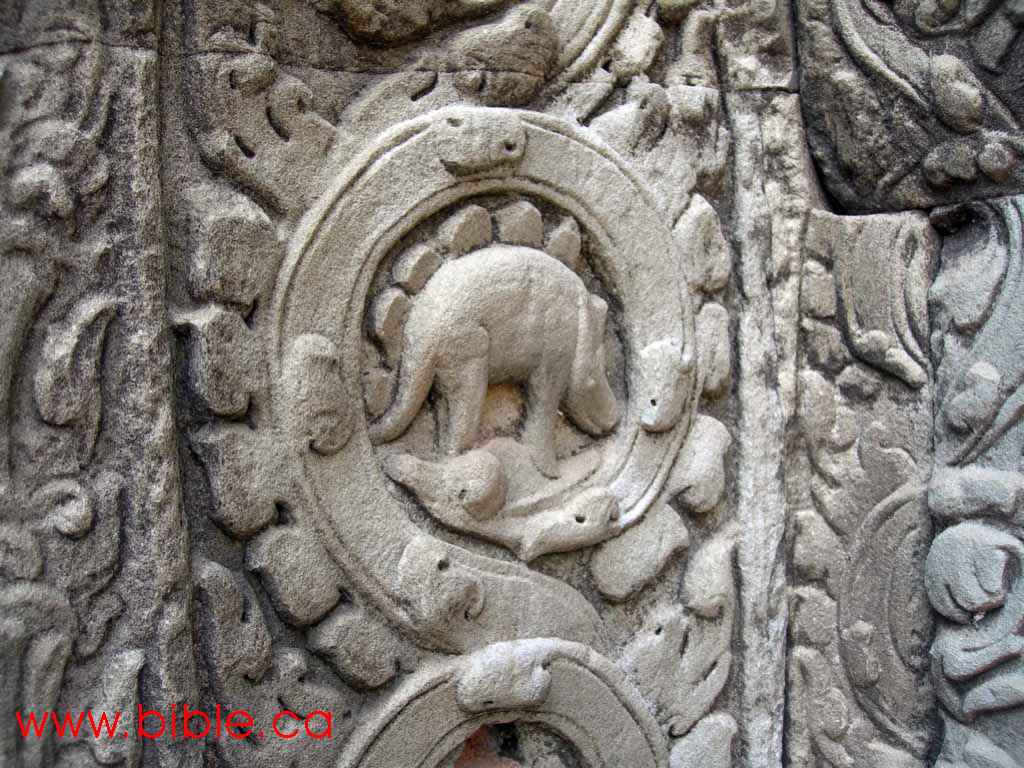
Ta Prohm abounds with stone statues and reliefs. Almost every square inch of the gray sandstone is covered with ornate carvings. Hundreds of decorative stone circles surround familiar animals, such as monkeys, deer, water buffalo, parrots.
(monkey upper left, deer upper right)
(water buffalo upper left, two parrots upper right)
 |
 Here are two examples of swans left and above. |
The obvious indication is that the stone carvers of the tenth century saw a stegosaurus as they saw monkeys, buffalo and deer.
Below: The area of the stegosaur appears lighter (especially the raised portions) because it was cleaned by the famous photographer described below. Nevertheless, the "patina" is still obvious in the recesses (Note under the tail, under the chin, in front of both legs, on top of the "ground" between the legs, above and between the plates on the back).
(Click on photo below for high resolution)
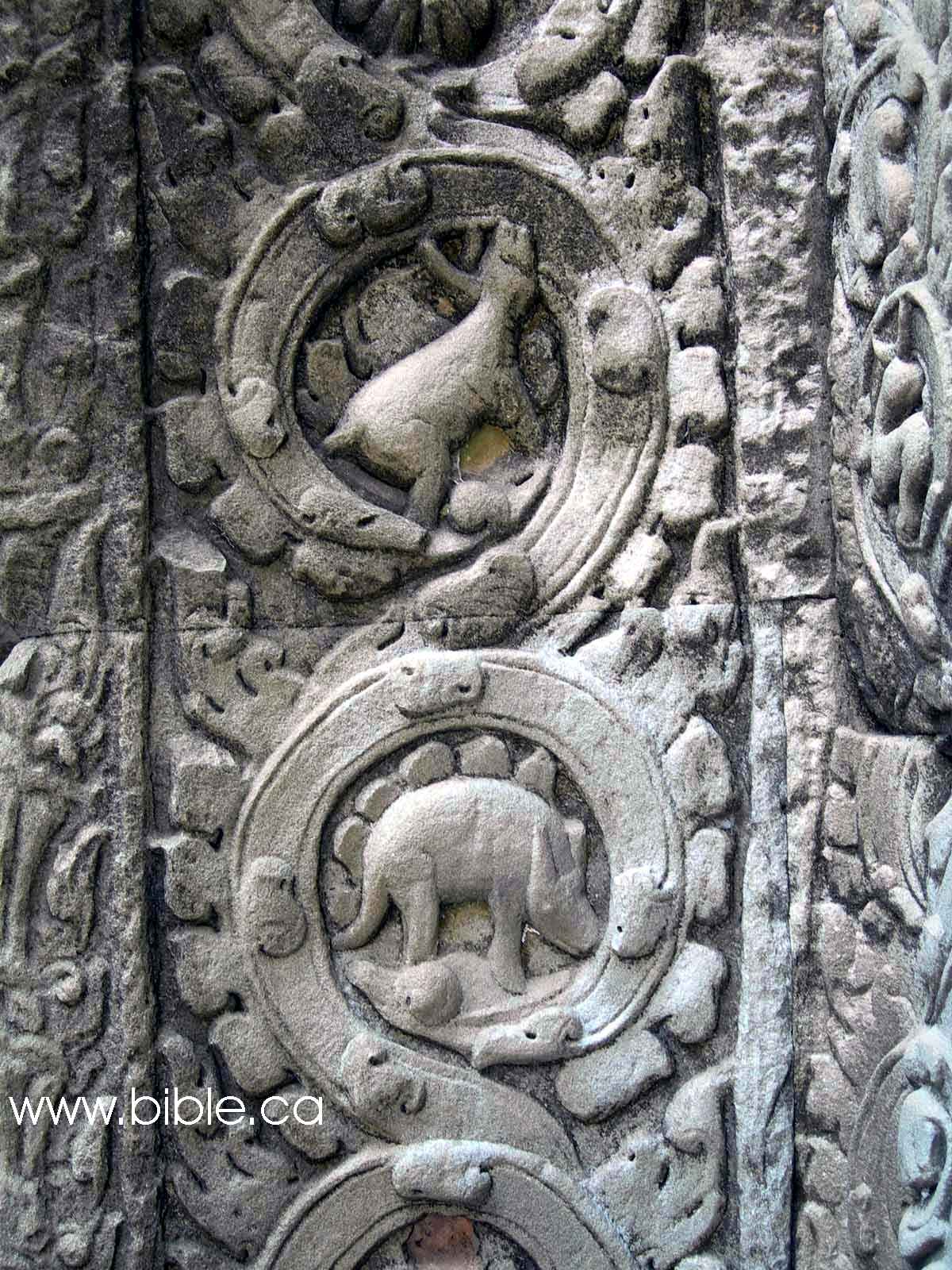
The area around the Hindu god Indra (below) seems to have been cleaned in a similar manner.
The idea that the carving may have been added recently is simply not possible for at least a half-dozen reasons.
- Patina is still obvious in the recesses.
- The depth of relief on the carvings that cover every square inch of this column, is more than half an inch. Removing the imagined "original" carving would have left a recessed surface. Then, carving the stegosaur on the recessed surface would require still deeper recesses. The above photograph clearly demonstrates that the carving is not recessed. It is flush with the other carvings. Since the plates on the back of the stegosaur protrude from the recessed background at least half an inch, it would not be possible to add them to the background by subsequent carving. The plates are an integral part of the rock surrounded by a recessed, patina covered background.
- There is approximately 40 feet of overburden that would have been displaced in order to replace the entire block.
- The blocks are held together, not with mortar, but with iron "staples" in the shape of a capital "I" typically about 8 inches long, 1.5 inches wide and 3/8 of an inch thick. An inset in the shape of the staple was carved into the surface of two adjoining blocks, across the abutment, one end in one block and the other end in the other. With the staple in the shaped recess, the next tier of blocks holds the staple in place. They are used horizontally and vertically.
An interesting sidelight is that I observed and photographed this method of construction in Tiahuanaco, near Lake Titicaca in Bolivia. (see below) Bolivia is around the world from Cambodia, yet the staples appear to be identical.
However, the point that we are making here is that the blocks are interlocked in such a way that removing and replacing a block with 40 feet of overburden without detection, is an imaginary idea that will not work.
5. It may sound presumptuous, but I am trained in petrology. I know rocks. If someone had altered this rock, years after the original carvings, I would see it immediately. It would also be obvious to other experts who have carefully examined this carving (documented below). I can tell you without the slightest doubt, this carving is not modern, it is contemporary with the other carvings of Ta Prohm.
6. It should also be mentioned that the mind-set in Cambodia is very different form ours. The people are still greatly intimidated by governmental authorities. The brutal execution millions for almost any excuse, is vivid in the memory of virtually all adults in this country. Some of the same government officials responsible for the slaughter of perhaps 1/4 of the population are still in power today in this communist dictatorship. Consider this in connection of the fact that dozens of federal police with AK 47's patrol the ruins day and night, daring anyone to deface or take "souvenirs." It is simply not credible to imagine pranksters, defacing and re-carving these "sacred" temples, which are still actively used today for Hindu and Buddhist idol worship.
(Click on photo below for high resolution)
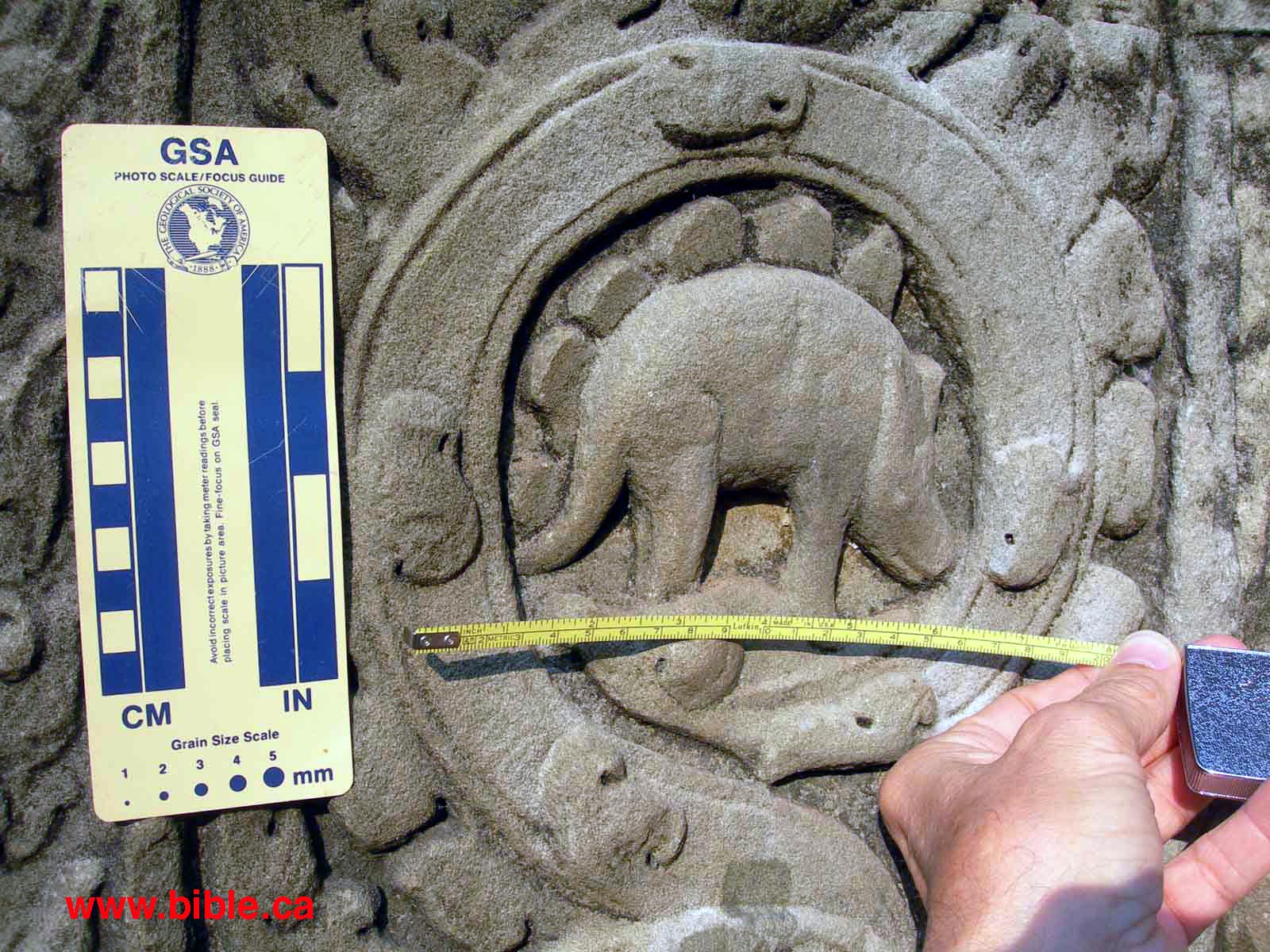
| At least two very significant books testify to the authenticity of the stegosaurs carving. Ancient Angkor was first published in Thailand in 1999 by River Books Ltd., Bangkok. A small picture of the carving is seen at the bottom of page 143. On page 144 we read, "Along the vertical strip of roundels in the angle between the south wall of the porch and the east wall of the main body of the gopura there is even a very convincing representation of a stegosaur." |
 |
|
 |
The large, beautiful 320 page book, Angkor, Cities And Temples, by the same author and photographer, includes a half page picture of the stegosaur sculpture. On page 213 the author describes it as "an animal which bears a striking resemblance to a stegosaurus". | |
"Author: Claude Jacques, a long standing member of the Ecole Francaise d'Extreme Orient, lived in Cambodia for nine years where he taught Khmer history at the Archeology Department of Phnom Penh. Throughout this period he also pursued his research which frequently took him to Angkor and its surrounding cities. He has been the director of studies at Ecole Pratiques des Hautes Etudes for the last twenty years, teaching the history of Southeast Asia. He is an expert in Sanskrit, Khmer and Cham scripts and is closely involved in the various restoration projects being undertaken at Angkor." (Angkor, Cities And Temples, Book cover)
This book has a Forward written by the director of UNESCO who says:
"There are excellent reasons for Claude Jacques to have written this new book on Angkor. Following the 'solemn appeal' which I made in November 1991, and the 'Tokyo Declaration' of October 1993, a co-ordinated internation effort has been set up to safeguard and develop Angkor. Despite the huge challenge, the formidable obstacles and the many perils, all concerned have regained their confidence and hope. Four years of determined effort have been rewarded with remarkable success ..." (Federico Mayor Director General, UNESCO Paris, 1997)The book cover also describes the photographer:
 |
"Michael Freeman's photographs have been published in leading magazines such as GEO, The Sunday Times Magazine, the Smithsonian, and Life. He has also worked on numerous books including Ancient Capitals of Thailand and Palaces of the Gods: Khmer Art and Architecture in Thailand. He has specialized in photographing Southeast Asia for more than a decade." The book cover of, Ancient Angkor, adds, "He was the first photographer to have prolonged access to Angkor after the country's two decades of war, genocide and civil war." |
A few skeptics have based their objections on anatomical differences between popular Stegosaurus restorations and the Cambodian sculpture. The fact that the average Jr. High student immediately identifies the sculpture as a Stegosaurus is considered of no consequence. "The head is too large Stegosaurs had no horns or frills on the head" The sculpture has no spikes on the tail... Therefore, they conclude that the sculptor never saw a Stegosaurus.
One is tempted to respond to these claims by pointing out that our modern restorations involve some guess work, that Stegosaurs may have exhibited a significant amount of anatomical variety (like dogs), that a view of tail spikes may well be blocked by the surrounding stone circle, etc., etc. However, this line of reasoning focuses the discussion on the wrong issue. The relevant question is not, Can you find anatomical differences with today's popular restorations? Rather, the real question is, What kind of sculpture would be produced by an artist who remembered seeing a Stegosaurus?
Consider the following brave observation regarding this sculpture by an author unknown to me, posted to a web site dominated by skeptics.
"As an artist myself, I find it amusing that skeptics are picking at the anatomical incorrectness of this rendering. If I were going to draw a stegosaurus from memory, that's what it would look like, by gum. And of COURSE it was done with a chisel. Just like the rest of the wall. Sheesh. Most artists have handwriting,' and this artistic style matches the rest of the pictures, as well. Isn't the triceratops head frill a neat addition? It's actually more convincing to me than if it HAD been a perfect replica. Says that there was some confusion there. Combined legends? Conflicting sightings? Cool."Assuming the sculptor did not have a Stegosaurus trained to pose as a model, and there was no access to the internet, the rendering would most likely be from memory. Would the results of this process necessarily be anatomically correct compared to today's restorations? What would it look like?
Instead of relying on wide ranging, presumption serving speculation, I determined to answer the question by means of an experiment. I persuaded an art instructor at the University of Texas at Arlington to assign an art class (Communication Graphics) the task of drawing a Stegosaurus, from memory. These college students were not paleontologist nor were they professional artists. They were students studying art. The analogy is not perfect but the experiment should provide insight into our question, "What would an artist produce from memory?"
There were 36 students in the class. The following 12 drawing are the best of the lot. I think you will agree with the instructor's assessment that none of the students' efforts looked as good as the sculpture on the temple wall in Cambodia.
I was struck by the similarity between the Cambodian Stegosaurus and a picture frame I have used for years to display a picture of my niece.
It's not a perfect representation but then it is not intended to be. Tail spikes would not fit the style. Terms like stylized and artistic license are familiar because we all know that artists do that. Some of the animals at Ta Prohm are very realistic but some are not. The swan is readily recognizable from Hindu tradition but is somewhat stylized and certainly not anatomically correct.
|
|
Here are four examples of swans left, above and the two below. |
 |
 |
How, then, should we assess the assertion that the Cambodian sculptor never saw a Stegosaurs because his depiction is imperfect (though better than the art students)? The students must have seen a Stegosaurs but the Cambodian sculptor did not??? You think? Prejudice has the power to makes us look awfully ridiculous.
Subscribe to:
Posts (Atom)
Youths writing Khmer words in Latin should not be normalised https://www.khmertimeskh.com/50760500/youths-writing-khmer-words-in-latin-sho...

-
Click here for link American Embassy, Phnom Penh, Cambodia: http://usembassy.state.gov/cambodia/ ASSOCIATION FRANCAISE POUR LA REC...
-
Contrasting Predominant Values of American and Cambodian Values 85 rate or flag By ecoggins Cambodian Treasure Angkor Wat ...
-
 នយោបាយភាសា ៖ បរិបទ កម្ពុជា សិង្ហបុរី និង ចិន Politics of language: Context in Cambodia, Singapore and China បណ្ឌិត វង្ស មេង អនុប្រធានវ...
